
|
| UVB & DNA | Creating the Context Default |
|

Creating the Context Home Research Focus Background Info Research Methods Data Submission Results of Study Data Analysis Conclusion Further Research Guided Research Research Question Background Info Research Methods Data Submission Results of Study Data Analysis Conclusion Further Research Research Values Student Research Doing Research Publish View Tools Discussions UVB Links
|
GENERAL ULTRAVIOLET SKIN EFFECTSunsor, Inc.The following pertains to the most recent information available from dermatologists, photobiologists, and meteorologists, and can assist in the selection of daily activities regarding sun exposure and avoidance. What are these UV rays that have such a valuable yet detrimental effect on mankind? Ultraviolet is just a small portion of the electromagnetic rays emanating from the sun, which include longer radio rays, infared heat rays, visible light rays, shorter UV rays, even shorter x-rays, and cosmic rays. Each of these rays influence our lives in various ways, but ultraviolet, which is just beyond the visible portion, influences human beings, partially in the form of skin burning and tanning, as well as causing ocular damage. Scientists have classified UV to be in a range from 200 to 400 manometers (a manometer is a unit of dimensional measurement), and have further divided ultraviolet into 3 categories, UVA (tanning rays from 320 to 400 NM), UVB (burning erythema rays from 280 to 320 NM), and UVC (germicidal rays from 200 to 280 NM). The Sunsor UV meter was designed to measure only the rays that cause tanning and burning (UVB). The amount of UVC that reaches the earth's surface is limited, due to blockage by the earth's atmosphere. Photobiologists have determined and labeled the amount of UV energy required to cause reddening of the skin, as a minimal erythemal dose (MED), and have accurately defined this value in terms of UV energy received for a precise period of time. This UV time-intensity relationship is shown as the "MINIMAL" curve on the Sunsor Exposure Guide. For any level of UV intensity, a corresponding period of time is defined that will produce the same effect on the skin. 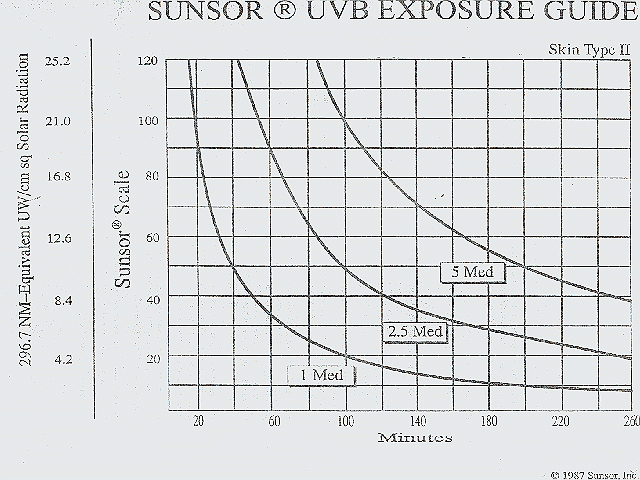 Using this relationship, Sunsor established a certain level of UV intensity as being equal to 100 on the Sunsor Scale. This arbitrary value was selected since the level of this type of UVB energy is close to a maximum in South Florida, at noon, on a clear, midsummer day. Obviously, the value could be higher than 100 under certain conditions, such as:, being closer to the equator, at a higher elevation,fewer clouds, less pollution, in an area of ozone depletion, etc. In fact, the amount of UV radiation reaching the earth depends upon these elements and others including the time of day, time of year, geographical location, reflective conditions, absorption conditions, etc. Although a predicted high is available for all geographical locations for any hour of the day, the above factors can and will influence any local reading. Some lesser known facts should also be considered. The total amount of radiation from the sky, caused by absorption and re-radiation is approximately equal to that of direct radiation from the sun. This re- radiation is called "sky effect", and it is possible to be in direct sunshade and still receive a severe burn. Obviously, trees and buildings block a portion of this radiation and this accounts for the fact that burning occurs more frequently on a beach, which is typically open, rather than the back yard. White sand reflects as much as 20%, snow reflects up to 90%, buildings reflect various amounts, but water reflects very little. Much of the UV is absorbed and scattered by the water, which is why it is. possible to receive a sunburn while under water. Also, high altitudes will normally have a higher UV level due to less blockage. Skiers are aware of the phenomenon of sunburn occurring under the ears, nose, and chin. This is a result of the high level of snow UV reflection and generally the higher altitude, which is why the individual must be aware of the total UV intensity not only from the direct rays of the sun, but also from reflection and re-radiation sources.  Some dermatologists believe that the skip aging process is about 70% due to overexposure to the sun. These same dermatologists suggest that extra precaution be taken if the individual is taking certain drugs. Some medications can cause the skin to react differently to sun exposure than it would without the medications. Since 1988 TV weathercasters have had the ability to report daily ultraviolet intensity levels and, much like they report temperature, make local daily UV report. Many TV stations have readings with the Sunsor UV meter. The UVB meter used in the project is available at the price of $39.95. It is in a pocket size wallet 2 1/4 x 3 1/2 x 1/2 inch tapered, weighs 1.5 oz. and is solar powered (Trademark of Sunsor, Inc.@ Copyright 1988 Sunsor, Inc.).
|
| © 1997-2003 PathFinder Science |