Water Quality Index Research Methodologies: Fecal
Coliform
[Fecal Coliform Research Background]
How to do a Fecal Coliform
Test
There are several ways to test for fecal coliform. Some tests only
indicate the presence or absence of the bacteria. Others indicate the relative
amount of bacteria present in a sample. Two methods are described below
for determining the relative amount of fecal bacteria present in a sample.
METHOD I: Using the Coliscan
EasyGel (ReadyGel) Method
Collecting the Sample:
Use a sterile pipet to collect a 2 mL sample from below the water
surface.
Using Redigel as a Pour Plate:
- Remove the cap of a Redigel vial and add the 2 mL amount of
sample. Swirl gently to distribute the sample.
- Tilt the lid of a pretreated petri dish and pour the Redigel/sample
mixture into the dish bottom. Replace the lid and gently swirl until the
bottom is covered.
- Carefully tape the lids to the bottom of the petri dish.
Dishes should not be opened once prepared.
- Allow 45 minutes for the gel to solidify.
Invert and incubate as
desired. It is best to incubate at a temperature range between 85-99 degrees
F. They can be incubated at room temperature but will take longer to
grow.
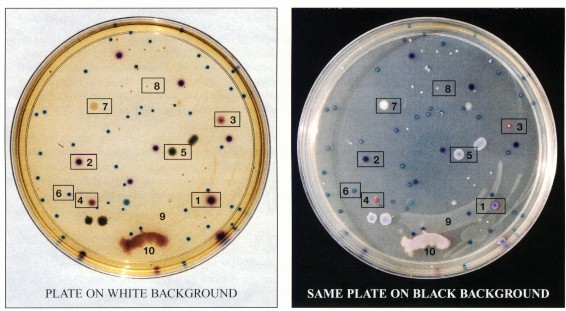
Coliscan pour plate key.
- After 24 - 48 hours, count the number of purple colonies and
colonies with a purple halo. Multiply the number by 50 to determine the
approximate number of fecal coliform colonies in a 100 mL sample.
- When finished, sterilize the plates before disposal by submerging
them in a mixture containing one cup of bleach and three cups of water for
twenty minutes.
NOTE - Use only the provided pretreated petri dishes. Plain
petri dishes will not solidify.
CAUTION - The bottle medium and petri dishes are both sterile. Do not
contaminate when opening and using the product.
WARNING - DO NOT OPEN PETRI DISHES TO COUNT
THE COLONIES. WASH HANDS THOROUGHLY AFTER
HANDLING THE SAMPLES.
METHOD II: Using Hach Millipore
Filters
Collecting the Sample:
Remove the cap of a sterilized bottle just before sampling. Avoid
touching the inside of the cap. Use gloves and hold the bottle near its bottom. Plunge it (opening
downward) below the water surface, then turn the bottle underwater into the
current and away from you. Do not sample the water surface or bottom sediments because
they often contain greater numbers of fecal coliform bacteria. Allow some empty space
in the bottle to allow mixing. Replace the cap.
Ideally, all samples should be tested within one hour of collection. If
this is not possible, the sample should be placed on ice and tested within six hours.
Test Procedure: Read all directions and end notes carefully
before beginning.
- Label the bottom of a petri dish (side with the numbers) with the
date, name of the group, test site location, and percent of dilution.
- Use the blue plastic ampoule breaker to break the top off of a F-C
broth ampoule. Pour the contents of the ampoule onto the white absorbent pad in
the dish.
Be careful not to touch or breathe on the inside of the petri dish or its
lid. Throw the glass ampoule away.
- Set up the sterilized filtration system.
- Unscrew the top half of the filtration system. Carefully tear
open a sterile
filter membrane. With sterilized tweezers, carefully pull the white filter
membrane from
between the blue cover papers. Place the filter membrane, grid side up, on the
center of the filtration system. Be careful not to touch the membrane or
filter system. Be sure the filter membrane lies completely flat with no wrinkles.
- Screw the top half of the filtration system to the bottom half
making sure
the filter membrane is centered. (Some filtering apparatus use magnets to
hold the two halves together.)
- Use a clean graduated cylinder to measure out 100 mL of sample
water.
- Unscrew and remove the lid on the filtration system. Pour the 100 mL
water sample into the top of the filtration system and replace the lid.
- Pump the sample through the membrane.
- Carefully remove the lid from the petri dish that was set aside earlier.
- Unscrew the top half of the filtration system. Use sterilized
tweezers to remove
the filter membrane and place it grid side up into the petri dish. Be sure
not to touch anything.
- Make sure that the membrane lies flat on the absorbent pad. Place
the lid back on the petri dish.
- Place the petri dish in a ziplock plastic bag or some other type of
waterproof container.
- Check to see that the temperature in the waterbath incubator is set at
44.5oC. Place the ziplock bag into the waterbath incubator and incubate for 24
hours.
- Clean and put away the test equipment.
- After 24 hours, remove the sample from the incubator. DO NOT TAKE the
lid off of the petri dish. Use a 10x magnifying glass to count and record the
number of blue dots that have appeared on the filter membrane. Each blue dot is one
colony of fecal coliform bacteria. Cream or gray colored colonies are non-fecal
coliform bacteria. Colonies should be counted within 20 minutes of removal from the incubator to be sure color changes do not occur.
- Dispose the petri dish by placing it in a solution of one part
bleach and three parts water for at least twenty minutes. Then the dishes may be
safely disposed by placing them in plastic bag and putting it into the trash.
NOTE - a negative control sample using pure uncontaminated water
should be run at first to be sure the system is clean. A positive control sample
using water that has fecal coliform bacteria in it should be run last to prove that the
system is working.
NOTE - If an unknown sample is being tested it is recommended that (in
addition to the normal 100 mL sample) a 10% and 50% dilution sample be run.
A sample should have between 20 and 80 colonies. If more than 80 or less than 20
colonies are present the accuracy of the results are questionable.
NOTE - Do NOT use deionized water for dilutions. It is best to
use pure bottled spring water.
|